More E&P TECH REPORTING
Tech Talk
Artificial intelligence has already begun reshaping journalism, but according to media strategist and former newspaper executive Guy Tasaka, the next evolution may have an even greater impact on local news organizations. In this month’s column, Tasaka argues that while generative AI helped publishers work faster, the emergence of agentic AI — autonomous systems capable of planning, executing and completing complex tasks with minimal human oversight — could fundamentally change how local media companies operate, innovate and grow despite limited staff and shrinking budgets.
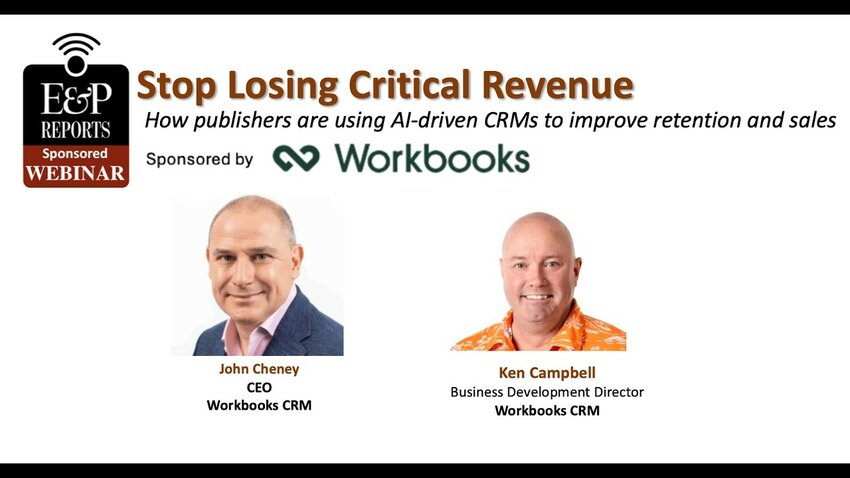
Publishers do not have a CRM problem. They have a revenue visibility problem. In this E&P sponsored webinarWorkbooks CRM CEO John Cheney and Business Development Director Ken Campbell argued that as media companies juggle advertising, subscriptions, events, first-party data and AI, the real challenge is no longer simply collecting information. It is turning disconnected customer data into clearer sales strategy, stronger advertiser relationships and more predictable revenue growth.
News Media Today
E&P columnist Rob Tornoe says a recent viral video featuring a former NFL head coach left him more uneasy than amused. For the first time, he couldn’t immediately tell if what he was watching was real or a convincing AI-generated deepfake. That moment, he writes, underscored how blurred the line between fact and fabrication has become — and how even seasoned journalists now struggle to trust their own eyes. As Tornoe explores in his latest column, deepfakes are no longer crude internet novelties but powerful, accessible tools reshaping political campaigns, public perception and the fragile foundation of media trust.
The internet once promised publishers limitless reach — then siphoned away their revenue. Now, generative AI threatens to deliver answers without clicks, leaving journalism with vanishing audiences and empty ad slots. Court battles may drag on for years, but a new crop of AI marketplaces is moving fast to fill the gap, offering publishers something they haven’t had since Google and Facebook ate their lunch: a way to get paid for their content. TollBit, ProRata, Cloudflare and Perplexity each claim they’ve cracked the code. The question is whether these models represent a lifeline — or just another false dawn.
Tech Talk
In his latest “Tasaka’s Tech Talk,” Guy Tasaka draws a stark comparison between farmers who clung to horses in the early 20th century and publishers who hesitate to embrace AI today. Just as tractors multiplied productivity and transformed agriculture, AI is rapidly becoming the engine that will separate thriving media companies from those stuck in the past. Tasaka argues that the choice is clear: embrace the tools that expand capacity, speed and efficiency — or risk being outpaced by competitors who already have.
With newsroom jobs shrinking and freelance rates collapsing, more journalists are turning to AI gig platforms like Outlier to make ends meet. The work ranges from editing grammar to testing models for harmful outputs — sometimes at rates as low as $10 an hour after unpaid training. Advocates warn that while the gigs offer short-term relief, they also carry hidden costs: burnout, poor pay and ethical dilemmas about helping build the very systems disrupting journalism.
Artificial intelligence is no longer just a Silicon Valley experiment — it’s showing up in the workflows of scrappy startups, statewide broadcasters and national newsletter networks. From a small New Jersey outlet using AI to publish a dozen daily newsletters, to Michigan Public building a searchable transcript database of hundreds of town meetings, to 6AM City scaling community newsletters to more than 400 cities, the experiments are multiplying. The lesson? Generative AI proves most powerful not when it replaces journalists, but when it’s matched to newsroom needs — filtering vital health bulletins, digging through government records or automating tedious production work. As Bob Sillick explores, AI’s true value in media is emerging not in theory, but in practice.
Artificial Intelligence is no longer a side conversation in the news business — it’s the headline. Generative AI is advancing at breakneck speed, and while some publishers see efficiency and opportunity, others see risk and disruption. To cut through the hype, E&P recently surveyed news publishers of all sizes, from tiny weeklies to major media companies. The responses reveal a split industry: eager adopters using AI for transcription, copyediting and audience insights on one side; skeptics warning of accuracy problems, copyright concerns and eroding trust on the other.
Tech Talk
Guy Tasaka has a blunt question for media executives: You’re still using free ChatGPT for everything, aren’t you? He sees it all the time — leaders treating AI like a novelty instead of the business transformation tool it is. “They’ll spend $500 on a dinner,” he says, “but won’t invest $20 a month in technology that could revolutionize their content creation, proposal building and marketing operations.” For Tasaka, that reluctance isn’t just short-sighted — it’s money left on the table every single day.
Media SaaS
In his new E&P column, Todd Handy — a proven growth architect behind major transformations in digital media, AdTech and SaaS — brings Silicon Valley strategy to Main Street media. Each month, Handy will show local media leaders how to think (and grow) like a SaaS company, breaking down essential metrics like CAC, LTV, MRR and NRR — and translating them into real-world, revenue-driving strategies for publishers. If you’ve ever felt lost in the alphabet soup of growth metrics, this column will be your decoder ring — built for media insiders, not tech bros.
Tech Talk
Big tech has overpromised and underdelivered for local media. Now, E&P’s tech expert Guy Tasaka argues the real future lies in micro-SaaS, no-code tools, and affordable “good enough” solutions. After decades of enterprise complexity, small, scrappy platforms are finally solving the problems big vendors ignored — and doing it faster and cheaper. If you’re still waiting for the perfect system, you may already be falling behind.
While you may be unfamiliar with the term OSINT (open source intelligence), you’re likely already aware of how it’s used. It’s collecting and analyzing data gathered from open source, publicly available information to produce actionable intelligence. Local newsrooms and publishers are discovering how OSINT improves journalism and business intelligence.
The tech industry drives the U.S. economy, shaping every sector. Veteran journalists Todd Bishop (GeekWire) and Casey Newton (Platformer) share insights on covering Big Tech, AI and startups — highlighting innovation, policy impacts and evolving media strategies that engage audiences through newsletters, podcasts and investigative reporting on the future of technology.