Latest E&P Exclusive Reporting

This week, Rep. Claudia Tenney (R-NY) introduced the Community News and Small Business Support Act (H.R.4756) to the U.S. House of Representatives with co-sponsor Suzan DelBene (D-WA). At its core, the bill lays out a five-year plan to provide payroll tax credits to local/community news outlets, expressly to hire and retain local news reporters across the country. Small businesses (with fewer than 50 employees) that advertise in local newspapers, digital news sites, on local radio or with local TV stations are also eligible for tax credits.

A great new bill has been introduced in the House of Representatives to strengthen local news — important not just for its substance but its champion. The Community News and Small Business Support Act (HR 4756) attempts to address a horrifying phenomenon: local news is disappearing from thousands of communities across the country. Two newspapers are closing each week, on average. There’s been a 57% drop in newsroom employees since 2004. Thousands of towns have no local news source or “ghost newspapers” barely covering the area.
In this episode of "E&P Reports," we look at the last few weeks in the life of Canadian news publishing through the eyes of Paul Deegan, president and CEO of the country’s largest industry trade organization, News Media Canada. Deegan unpacks the similarities and differences between Canada and the U.S. in national advocacy of Big Tech compensation legislation. He also discusses the battles that are now going on between Google /Facebook and the Canadian government as the digital platforms threaten to remove news content within the country, and Ottawa fights back by pulling ad dollars from the platforms.
Danielle Coffey’s first few weeks leading the News/Media Alliance (NMA) were anything but "business as usual." In her first 25 days as CEO, she and her team are addressing some of the most critical issues and advocacy facing news media's future, including Gannett’s recent antitrust filing against Google; Canada's final passage of the their Journalism Compensation Bill and how this may impact the U.S. Congress passing similar legislation.
In this episode of “E&P Reports,” we go one-on-one with National Press Photographers Association (NPPA)’s general counsel, Mickey Osterreicher, to gain some advice on how both the news industry and the nation's law enforcement can work better together to respect the 1st Amendment, while each goes about their tough jobs during times of crime and crises. We also chat with him about his perspectives on helping define who a journalist is, especially now, as so many citizens are recording news on their personal devices.
Latest Industry News

A federal appeals court has upheld an injunction won by Cumulus Media against Nielsen, agreeing with a lower court that the ratings giant likely violated antitrust law by leveraging an alleged monopoly over national radio data to pressure broadcasters into buying local data they didn’t want.

Justice Department officials met with broadcast-television station operators earlier this week as part of its antitrust investigation into the sports-media marketplace, according to people familiar with the matter.
One of the most consequential legal battles in recent radio history is now on ice, and when, or if, it ever resumes is far from certain. A federal judge has stayed the entire Cumulus Media antitrust lawsuit against Nielsen following Cumulus’ filing for Chapter 11 bankruptcy.
By entering into negotiations with Ottawa, Meta, which owns Facebook and Instagram, has tacitly conceded that it needs news content and that it is valuable for Meta. You might think that, having conceded this, Meta would do what normal companies do and pay for this vital input to its business.
The chairman of the Senate’s antitrust subcommittee is raising concerns over Netflix’s proposed acquisition of the Warner Bros. movie-and-television studios and HBO Max streaming service. 
A federal judge has agreed to limit how many details are released as part of Cumulus Media’s ongoing antitrust lawsuit against Nielsen. U.S. District Judge Jeannette Vargas says the “interest in protecting confidential business information outweighs the qualified First Amendment presumption of public access.”
A federal judge in New York has granted Cumulus Media’s motion for a preliminary injunction against Nielsen, blocking enforcement of Nielsen’s Network Policy in contract negotiations and establishing a competitive pricing benchmark for nationwide radio ratings sold as a standalone product.
A Manhattan federal judge concluded that the issue of Google’s liability for its monopoly on technology used by publishers to buy and sell online advertising was already decided by a judge in the Eastern District of Virginia.
Whatever remedy emerges, behavioral or structural, the outcome may end up being less of a reckoning and more of a temporary lift: a float for an ad-funded internet still trying to figure out what comes next. Here’s what to know as the industry braces for the fallout.
Related Resources & Documents

Information on the Journalism Competition & Preservation Act (JCPA), which would allow news publishers to collectively negotiate with the tech platforms for fair compensation for use of their content.

The Community News & Small Business Support Act delivers on this promise with content-neutral tax credits, sunsetting in five years, for (1) hometown news organizations to employ community-based local journalists and (2) small businesses for marketing themselves with their local media organizations. National news outlets are not eligible for these tax credits. Find out more about the Community News & Small Business Act here.

Rebuild Local News helped develop and strongly supports the Community News and Small Business Support Act (H.R. 4765), introduced by Reps. Claudia Tenney, a Republican from New York, and Suzan DelBene, a Democrat from Washington. Here are numerous resource links and information about this important legislation.

From investigative reports to breaking news and weather coverage, broadcasters invest significant resources to keep Americans informed. Local radio and TV stations provide a lifeline for our communities, but the dominance of Big Tech platforms is threatening the future of local journalism. The NAB is providing news and resources to help you support this important advocacy.

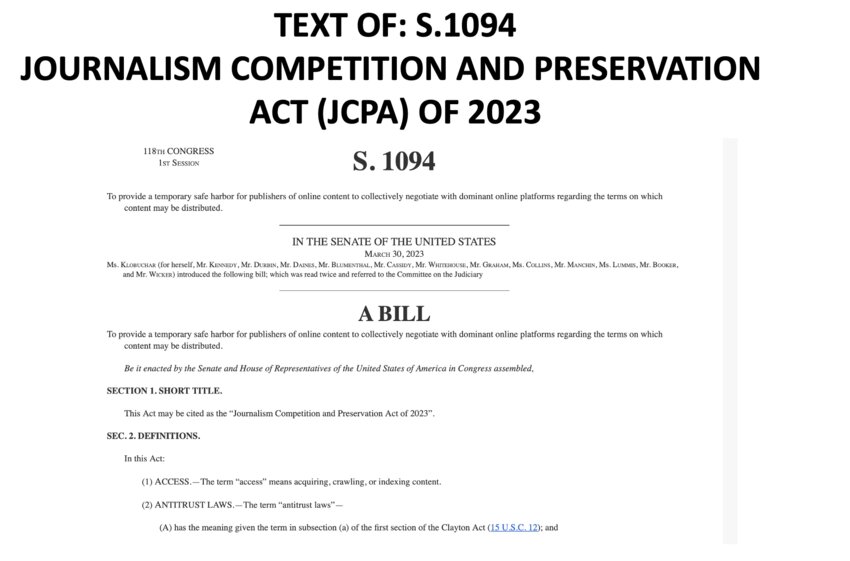
The actual text of S. 1094, the Journalism Competition and Preservation Act of 2023 filed by Sen. Klobuchar, Amy [D-MN] on March 30, 2023. On June 15th, 2023 her Committee on the Judiciary, ordered that S. 1094 was to be "reported without amendment favorably."

In January of 2023 the U.S. Department of Justice issued this online press release, with links to related resources about their antitrust suit against Google for monopolizing multiple digital advertising technology products in violation of Sections 1 and 2 of the Sherman Act.

As of April 2023, nine additional states joined the U.S. justice department’s suit against google for monopolizing digital advertising technologies, in violation of Sections 1 and 2 of the Sherman Act. The Antitrust Division and the state Attorneys General filed this amended complaint in the Eastern District of Virginia.

Canada's largest industry association: News Media Canada, posts ongoing content related to the recent passage of Senate Bill C-18, a law requiring Google and Meta to pay media outlets for news content that they share or otherwise repurpose on their platforms.

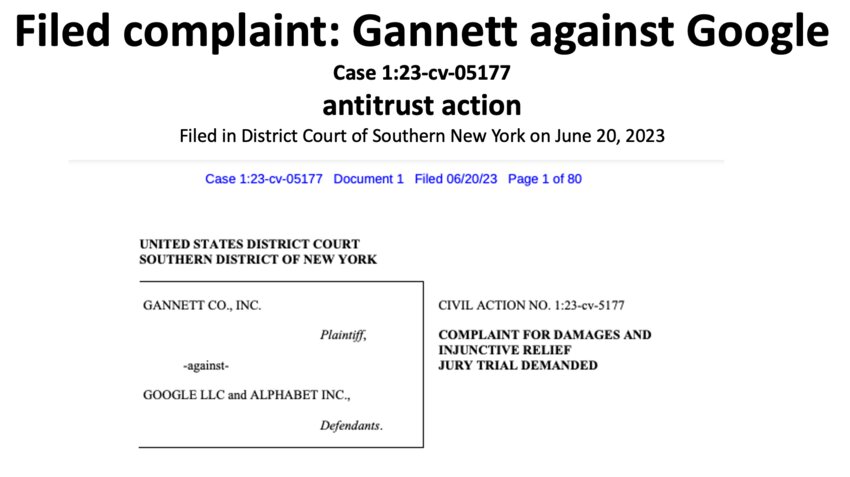
Gannett Inc, the largest newspaper publisher by total circulation in the country has sued Google over allegations that the company is violating antitrust law in controlling tools used to buy and sell ads. This is a copy of the actual complaint filed.

In 2021 antitrust litigation against Google was filed in the state of Texas by over 200 U.S. newspaper publishing companies. One of the major law firms involved in the case produced this extensive FAQ document about the lawsuit.

More Big Tech Compensation/ Antitrust Industry News

How to Stop Hedge Funds from Devastating Local News

With Alden Global Capital’s recent acquisition of the Tribune Publishing newspaper chain, the country has reached a troubling milestone: half of the daily newspaper circulation in America is now owned by hedge funds. This is a real threat to democracy because hedge funds and private equity firms have a track record of cutting the reporting staff of local newsrooms to increase profits.

From Antitrust to Zoom, Virtual is a Mainstay in 2021

In 2020, digital was a double-edged sword. It brought us closer together as in-person meetings and events moved online during the COVID-19 pandemic, and it divided us even more as misinformation and hate speech circulated dangerously on various social media platforms.
Read the current issue of E&P
Sponsored News & Case Studies from E&P Marketing Partners
A newsroom can win a lawsuit and still be destroyed by it. Years of legal bills, missed deadlines and relentless anxiety can accomplish what an unfavorable verdict never could: silencing journalists and frightening others away from the story. For a small publisher without in-house counsel or deep financial reserves, one legal threat can place the entire organization at risk. International media-freedom attorney Flutura Kusari warns that waiting until a demand letter arrives to build a defense may already be too late.
trusted relationships with local businesses. Duda gives them the white-label technology to transform those relationships into scalable, recurring digital-services revenue. Its enterprise platform helps media organizations deliver sophisticated websites and online tools that strengthen advertiser retention while helping local businesses attract customers and prosper. The publisher owns the brand and customer relationship; Duda supplies the infrastructure, automation and expertise working powerfully behind the scenes.
Investigative journalism is supposed to make powerful people uncomfortable. But for a 12-person nonprofit newsroom reporting on forced labor, human-rights abuses and environmental wrongdoing, a legal threat can become more than a distraction—it can threaten the organization’s ability to survive. That is why The Outlaw Ocean Project joined Reporters Shield.

As public trust in journalism continues to face historic challenges, the Center for Integrity in News Reporting is recognizing the journalists helping rebuild it — one newsroom at a time. During a remarkable three-week stretch in June, CFINR presented its new $5,000 Integrity in News Reporting Awards to outstanding journalists in six states, marking the program's busiest month since its launch. The awards celebrate reporting that exemplifies fairness, impartiality and objectivity while encouraging news organizations to uphold those same standards. With 22 states now participating, the initiative is quickly becoming one of journalism's fastest-growing recognition programs.
For Scott Anderson, overseeing 11 newsrooms across Louisiana and Arkansas means making hard decisions every day about what his teams can cover—and what they cannot. The Center Square has become a trusted supplemental reporting resource, helping fill gaps in enterprise, economic and local coverage. “They really have been a great extension of our newsroom,” Anderson said.
For decades, E&P’s Publisher of the Year award has recognized exceptional leadership across the news publishing industry. But today’s news media landscape extends far beyond traditional publishing, and the titles, platforms and business models shaping it continue to evolve. Now renamed E&P’s News Executive of the Year, the award honors the highest-ranking leader of any organization creating and delivering original news content—regardless of title, platform, ownership model or organizational structure. Nominate the visionary executive whose leadership is strengthening the news media business, building audience trust, inspiring innovation and positioning their organization for a relevant, resilient and sustainable future.

D-R Media and Investments of Venice, Florida, has selected SCS’s Community Advertising System to update and enhance its advertising and production workflows. By implementing CAS, D-R Media will benefit from a unified, organization-wide solution that supports display, classified and digital advertising operations, as well as invoicing, accounts receivable and customer account management.
As shrinking newsroom staffs continue leaving major gaps in statehouse and government accountability coverage, publishers across the country are searching for ways to preserve essential journalism without adding significant overhead. Increasingly, many are turning to collaborative reporting models and syndicated newsroom partnerships designed to supplement local coverage while allowing already-stretched staffs to stay focused on their communities. Among the organizations expanding rapidly into that space is The Center Square, a nonprofit newswire that distributes state and national reporting to more than 1,350 media partners nationwide.
Richner Communications, Inc., based in Garden City, New York, has selected SCS’s Community Advertising System to modernize and streamline its advertising, production and customer service workflows.
When Dublin Inquirer publishes a sensitive accountability story, the challenge isn’t just reporting the facts. It’s deciding whether a small, seven-person newsroom can afford the legal risks that sometimes come with telling the public what it needs to know. For editor and co-founder Sam Tranum and deputy editor Lois Kapila, those decisions once came down to late-night conversations and educated guesswork. Today, the independent Dublin newsroom relies on Reporters Shield’s Legal Risk Assessment service to help identify potential legal vulnerabilities before publication—allowing journalists to move forward with greater confidence while keeping important stories alive.