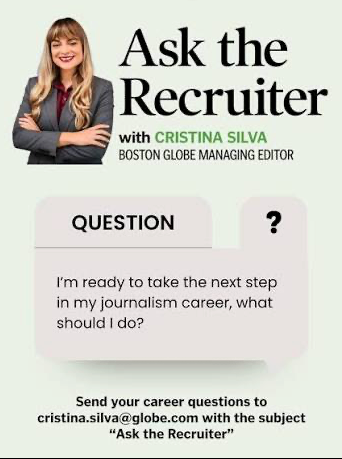
For job seekers, landing a newsroom job can feel increasingly dependent on luck, connections and an opaque hiring process. Cristina Silva, managing editor for Operations & Standards at The Boston Globe and the new author of Poynter’s Ask the Recruiter column, says candidates have more control than they may realize. The key is to understand how editors make decisions, communicate clearly and make it easier for a hiring manager to see your value.
Your career is not defined by one bad day
Silva’s first Ask the Recruiter column began with a story many job seekers will recognize. As a college student, she had pursued internships and devoted herself to journalism, only to have her car break down on the way to an interview. She arrived 40 minutes late, “sweaty and covered in car grease,” and lost the internship.
The experience stayed with her, but it also shaped the message she now wants to share with younger journalists. “Everyone makes mistakes,” Silva said. “Everyone has moments in their careers where they wish they could have done something differently.” Even diligent, talented people will face disappointments outside their control.
Her advice is to keep moving. “It doesn’t matter how far along we are in our careers, we all just have to keep pushing ahead and striving,” she said. “It’s a numbers game. You have to talk to a lot of people, you have to apply to a lot of jobs.” Rejection, she said, is not proof that someone does not belong in journalism.
Editors need candidates to make their case

Journalists are often trained to put the story ahead of themselves, an instinct Silva respects. But the job-search process requires a different posture. “A lot of us are very humble,” she said. “We always say that we are not the story. We just do the work and we hope that someone notices it. And that doesn’t work for the job application process.”
Candidates need to explain what makes them distinctive, quickly and specifically. Silva encourages every job seeker to prepare an elevator pitch. “How will you get someone’s attention in just one, two, three minutes?” she asked. Whether someone is seeking a raise, a promotion, a new job or a networking conversation, they must be able to distill their career and explain “why you’re unique, why you’re special, what you’re bringing to the table.”
That clarity matters in the interview itself. Silva said a candidate who takes 10 minutes to answer the first question in a 30-minute interview may lose the chance to show other strengths. “Be succinct and prepared,” she said. “Show your best self. Show that you can deal with stressful situations.”
Specificity also separates strong applicants from the pack. “A lot of people will just say vaguely, ‘Oh, I was a city hall reporter,’ or ‘I was a breaking news editor,’” Silva said. “That’s not enough detail.” Editors want to know what the candidate did, what they accomplished and why that experience will matter in the new role.
Show that you understand the newsroom
A strong application does more than list experience. It shows a hiring editor that the candidate has paid attention to the publication, the community and the work already being done.
Silva likes hearing from applicants who can cite recent coverage and explain how they might contribute. “I think it’s really great when you show that you’ve read the publication that you’re applying for,” she said. Better still, she said, is showing how you would fit into the team and move coverage forward. “I always encourage people to come to interviews with story ideas or to slip that into the thank-you note or to slip that into your cover letter.”
That same preparation applies to networking. Silva calls the online application system “the black hole,” not because candidates should avoid it, but because a job post can draw dozens or hundreds of applicants. “When we put up a job posting, we’ll get anywhere from 70 to 500 applicants, if not more,” she said. “And so it is very difficult to stand out in that way.”
She advises job seekers not to rely on one person or one route into a newsroom. “Don’t put all your eggs in one basket,” Silva said. “Don’t just chase one editor; chase many people who work there.” LinkedIn, email, colleagues and mutual connections can all help put an applicant on the right editor’s radar.
Use AI carefully and protect your reputation
Silva does not believe generative AI should write a journalist’s cover letter. “I’m not using AI in any of my journalism writing and/or editing,” she said. “I just don’t think that it’s a better writer than I am.” A generic, AI-written letter may make a candidate less memorable, not more.
She sees a limited role for the technology as a proofreading or review tool. A candidate might use it to catch spelling and grammar errors or identify language that does not fit a posting. But, Silva said, “I wouldn’t use AI to directly write it from scratch because I think that will be quite noticeable to many editors.”
The letter itself should be brief and direct. “Five to six short paragraphs at most is really helpful,” she said. Hiring managers are doing their regular jobs while trying to fill an opening, so applicants should make the case efficiently: why they want the job, why they deserve it and what they can do for the newsroom.
Candidates should also remember that editors may look at their public social-media presence. Silva said she has done so and has been concerned by candidates who publicly complain about colleagues or post material that raises questions about judgment. “I wasn’t sure I wanted to hire someone who did something like that,” she said.
For Silva, the larger purpose of Ask the Recruiter is not simply to help individuals find jobs. “My hope is that we can use this as a forum to discuss how the journalism industry is changing and where it needs to go and how we can support each other as journalists,” she said. The goal is stronger, more ethical and more inclusive newsrooms, staffed by people who can help journalism reach the communities it needs to serve.
|
|
|











Comments
No comments on this item Please log in to comment by clicking here