
If a society is to be measured by the way it educates its children — how successfully they’re being prepared for adulthood and the workforce of tomorrow — the United States is underperforming, especially in the case childhood literacy. The COVID-19 pandemic certainly didn’t help matters.

This generation of American children has lost so much related to reading and language. Students no longer learn how to write in cursive. Spelling, vocabulary and grammar are easily offloaded to Autocorrect and AI. In social spaces, strings of emojis replace the written word altogether.
According to the most recent National Assessment of Educational Progress (NAEP), only 31% of U.S. 4th graders are reading at or above proficiency; 40% are reading at “below basic” levels. Just 30% of 8th graders are proficient readers, while 33% of these students preparing for high school have below-basic reading skills.
Can the trend be reversed? And if so, by whom? Parents, teachers and librarians certainly, but news media can also be an ally. That was the idea behind Kid Scoop News, a nonprofit founded by Vicki Whiting. A former elementary school teacher, she knew firsthand how a newspaper could be a valuable classroom tool — inspiring kids to read, to think critically and to better understand their communities.
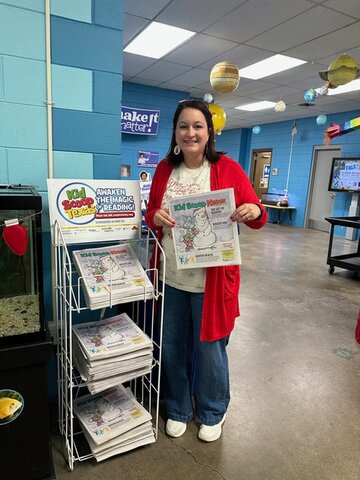
Whiting began thinking about “what fosters a reader, what gets a kid excited about reading,” she told E&P. Also, how can we encourage and enable kids to read at school and at home?
At the time, she taught primary school in her small town of about 10,000, she recalled. The textbooks lacked local and regional context, and her students bored of them. One day, she opted to set them aside and have discussions with her students about their community — what they knew about it, what they didn’t. She recalled how they sat up straighter in the chairs and became more engaged. The conversational lessons had context and relevance. And that’s what Kid Scoop News does. The monthly print edition and a weekly syndicated column called “Kid Scoop Weekly” are distributed as part of local newspapers and to schools, for use as classroom tools. They are made expressly with kids in mind.
“We have teachers tell us that when Kid Scoop News arrives at their classroom, they have to hide them until they’re ready to hand them out, because the kids are so excited,” Whiting said.

Whiting spends much of her time evangelizing Kid Scoop News nationwide and formalizing partnerships. Her colleague Debra Lambrecht — also a former educator — is executive director; she’s keenly focused on getting Kid Scoop News into schools and into the hands of kids all across California.
“I’m working with the local county superintendent of schools to look at a model that could be a way to get it in every school,” Lambrecht said.
Kid Scoop News is not a curriculum, they stressed. “It is an entry to reading for the kids who are anxious or don’t have the confidence or aren’t even familiar with the concept of print media. So, it needs to be engaging; it needs to be fun,” said Whiting. “It draws the kids in. I always call it a literacy intervention tool disguised as a newspaper.”
Whiting went on to cite studies by the American Pediatrics Association, which recommends printed books, magazines and newspapers for a child’s healthy reading development.
“As an educator, when you use a reading resource that’s connected to their lives, it makes them feel proud of themselves and accomplished. At the same time, they’re learning about their community, which leads to civic participation,” Whiting said.
 Gretchen A. Peck is E&P’s editor-in-chief. She welcomes your emails at editor@editorandpublisher.com.


1 comment on this item Please log in to comment by clicking here



loumarzeles
Our newspaper chooses to use Smartypants, a quality product and much cheaper than Kid Scoop.
Thursday, July 23 Report this