
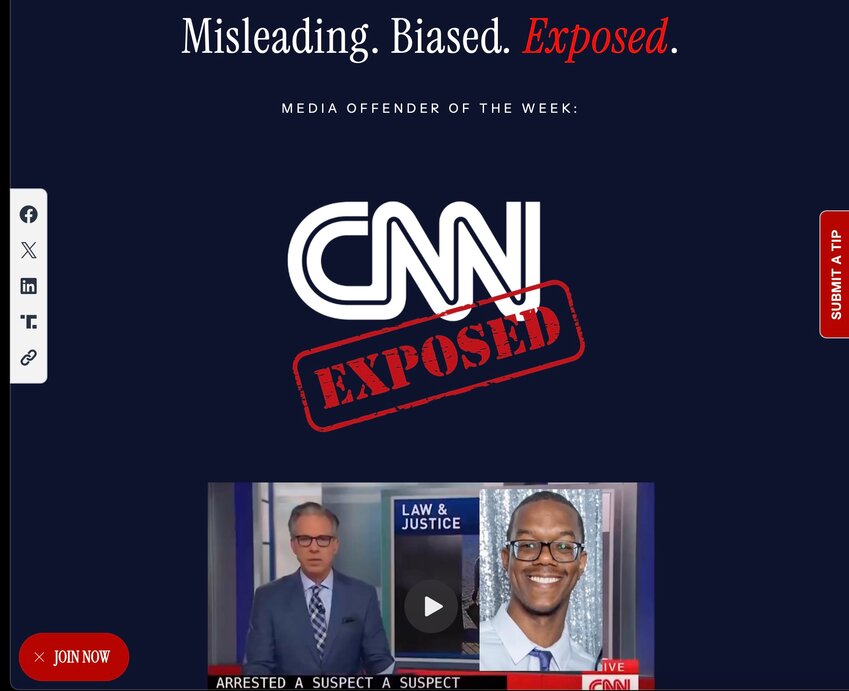
President Donald J. Trump has had a love-hate relationship with the press for decades. As a public figure and as president, he has exploited the press for his personal and political gain while intentionally undermining — through lawsuits and relentless rhetoric — the trust Americans place in the press. Late last year, the Trump administration launched a new portal on the official WhiteHouse.gov site to highlight reporting errors and allegations of media bias. A red “Submit a Tip” tab on the site implores the public to file their own grievances. CNN, The Washington Post, CBS News, Axios, public media outlets and others — networks, legacy papers and digital media alike — are cited.
Writing about it for the Guardian US, columnist Margaret Sullivan called the site “a desperate gimmick.”
On Dec. 1, the Society of Professional Journalists (SPJ) sent a letter to White House Press Secretary Karoline Leavitt, demanding the site be taken down.
By mid-February, the page was still live, though it hadn’t been updated since December. A White House official told E&P: “This page will continue to be updated. The White House is committed to holding the fake news accountable.”
Christoph Mergerson, Ph.D., is an assistant professor at the University of Maryland’s Philip Merrill College of Journalism, where he teaches journalism history. “History is useful not only for anticipating what might happen in the future, but also for helping us to put the present into context.”
“There is a long-standing history among presidential administrations and partisan institutions of being critical of press coverage,” Mergerson said. “On the one hand, you try to look at it through that lens, and this is nothing new. It has happened. It will happen. Elected officials will criticize journalists and their coverage as it suits them, but within the context of the Trump administration, you have to look at the bigger picture, the bigger context, to get a sense of what this really is all about. There is a list: the weaponization of the FCC to go after critics of the administration, both in journalism and on late-night television. You have weaponization of the Justice Department to prosecute journalists for doing their job of documenting newsworthy events.
“When you look at this particular action within the context of a longer string of actions, it’s very easy to reach the conclusion that none of this is in good faith, and that it is part of a coordinated series of actions to try to discourage people from holding this administration accountable. While past presidential administrations — Nixon comes to mind, President John Adams comes to mind — have a history of being adversarial with the press … this is something on a different level.”
At the core of the “Media Offenders” page is an allegation of political bias. Yet, missing from the page are overtly right-leaning outlets and pro-Trump advocates now counted among the White House press corps.
To push back and earn the public’s trust, Mergeson said the media needs to champion its “objectivity of method.”
“Journalism, at the end of the day, is a discipline of verification. We’re going to collect all relevant information we can. We’re going to analyze it using our own expertise. We’re going to use diverse sources to provide context for the information and confirm its accuracy. We’re going to test our assumptions,” he stressed.
“We fight over the meaning of the word objectivity, knowing it has different meanings. Maybe we ought to just say ‘good journalism — that is what we stand for,’ instead of confusing people with a word that has become loaded and weaponized, frankly, by partisans,” he concluded.
 Gretchen A. Peck is a contributing editor with Editor & Publisher. She has reported for E&P since 2010 and welcomes comments at gretchenapeck@gmail.com.






Comments
No comments on this item Please log in to comment by clicking here