
As news media organizations struggle to capture digital audiences, some are turning to social media stars to help deliver the news.
Collaborations between traditional news media and content creators — or influencers, as they’re sometimes called — may have been rare a few years ago, but as 2026 begins, they’re top-of-mind for anyone overseeing audience and engagement.
Jeremy Gilbert, Knight professor in digital media strategy at Northwestern University’s Medill School of Journalism, penned one of NiemanLab’s “Predictions for Journalism 2026,” titled “Publishers will finally learn the value of news creators.” In the column, Gilbert writes, “Audience members want to follow faces, not mastheads. … The creators news consumers follow on YouTube, TikTok, Substack and Ghost offer personality, affinity and transparency. In 2026, the news publishers that lead and thrive will be those that grasp what creators already know: Individuals command the attention that institutions need to survive.”
Like any successful partnership, a collaboration must begin with clear objectives. For the news media publisher, that may be:


There is no blueprint for these partnerships. They can be complex, requiring a negotiated contract, complete with compensation and deliverables. Or they can be simple promotional opportunities. Take, for example, the Richmond Times-Dispatch (RTD). E&P spoke with RTD’s Executive Editor Encarnacion Pyle and Features Editor Colleen Curran about the paper’s first annual “RTD 100” — a multiplatform project highlighting Richmond’s culinary scene.
“Richmond is really known for our food culture. … Our food culture is something that we celebrate, and we are doubling down on our dining coverage. It’s what our readers want to read; it’s what they click on. It’s what they love,” Curran said.

Four food writers, including RTD’s dining critic Justin Lo, visited more than 100 restaurants in search of the city’s best. Their discoveries were published in print and online. They produced videos for social and hosted a splashy launch party. They extended invitations to Richmond-based content creators, which helped build buzz — influencers like “The VAFoodie Team,” which has 57,300 followers on Instagram alone; “RVA Eats,” a photographer and food blogger with an Instagram audience of 13,000; and Megan Wilson, who publishes under the handle “sweetsauceblog” and has 39,200 followers on Instagram.
The creators posted before, during and after the party.
“It was a great way for us to meet new audiences,” Pyle said. “It was the perfect marriage and a way to get the product into the hands of influencers and the foodies who follow them. Though there was no way to really quantify it, I think we reached hundreds of thousands of new faces by doing that.”

A marriage of brands

Matt Miller has a unique perspective on news + creator collaborations from two vantage points. He’s the chief revenue officer at Trib Total Media and also serves as the chief operating officer for Brand Motives, the company’s advertising and brand marketing agency. For Brand Motives’ clients, creator collaborations are increasingly part of their campaigns, Miller explained. The agency’s website lays out four compelling arguments for working with content creators: engagement, authenticity, conversions and trust — all critical commodities for news media today.
“All the businesses we work with have pretty sophisticated social media presence. They take care of their digital presence. But, unless you’re running paid ads [on the social platforms], your content is really only being shown to people who already know you,” Miller said.
The most captivating content creators are known for their video production acumen, storytelling and “rizz” — the right blend of personality and information.
“They create content in their own voice, which is authentic, feels natural in their feed and is relatable to the people following them. It truly makes people stop scrolling and pay attention,” Miller observed.
To pair their clients with content creators, Brand Motives turns to a locally-owned partner, Run-Relay. It’s a firm that represents social talent, including “micro-influencers” with followings of 5,000 to 50,000.
“I really like the micro-influencer approach. For our clients, it’s not just about the follower count. It is relevance that matters more than reach,” Miller said. “These smaller, niche influencers drive stronger connections, because their audience is more engaged with what they’re doing on a day-to-day basis.”
“On the newspaper side, we’re looking at different ways to weave influencers into content we’re producing,” he said, citing TribLIVE’s annual “Best of the Best 2025.” Beyond simply publishing their annual best-business list, they expanded coverage for each of the top three winners in each category.
“For the gold winner, we brought in an influencer and weaved them into the story. It was a way we could create more value around the content, and because there are so many other best-of contests, it was a way that we could differentiate ours,” Miller said.
Collaborations of this kind “work best when they’re intentional, authentic and tied to a broader marketing campaign,” he said.
Brokering relationships
Marlene Harris-Taylor isn’t surprised to see more news organizations explore relationships with content creators. “It’s hot right now,” she said. Harris-Taylor is director of community engagement at the American Press Institute (API). Prior to this role, she reported for public media in Cleveland, where she first gained experience working with content creators. Early on, she recalled, there were “big headwinds” against these relationships. Some in the news media didn’t see the value, or felt content creators were competitive or at odds with their journalism values.
“I think the reason that the conversation is shifting is that people are seeing these partnerships; they’re seeing success,” Harris-Taylor said. “We see more and more research about how readers, the listeners, the viewers, if you will — particularly those 40 and under — this is where they’re getting their news. So, if you’re not in that space, you’re basically setting yourself up for extinction.”
API has convened two cohorts to study news media + content creator collaborations. The second class, consisting of 16 local newsrooms across the country, received $3,000 in grants to work with a local content creator on a one-off campaign.
Kansas-based Planeta Venus worked with a content creator to produce videos for TikTok, YouTube, Instagram and Facebook. “They had 100,000 views of this content. Their YouTube followers increased from 69 subscribers to close to 5,000 subscribers, just on the basis of this content,” she reported to E&P.
In Oklahoma, the Verified News Network enlisted Indigenous creators to spread the word about cultural events. “They had over 15,000 views across three Instagram Reels, which was way above their average of 21 views,” Harris-Taylor said. “They had about 3,500 views on TikTok, which was also a huge increase over their normal views. They gained 26 new Instagram followers and 22 new TikTok followers. They had 17 new email subscribers from this, and they even got donations.”
As with any business relationship, the contract is key. API published a “Guide to influencer collaborations,” which includes templated contracts, plus tips for finding and vetting creators in your community.
“Community leaders can also be trusted messengers, and many of them have big followings,” she said.
Collaboration as currency
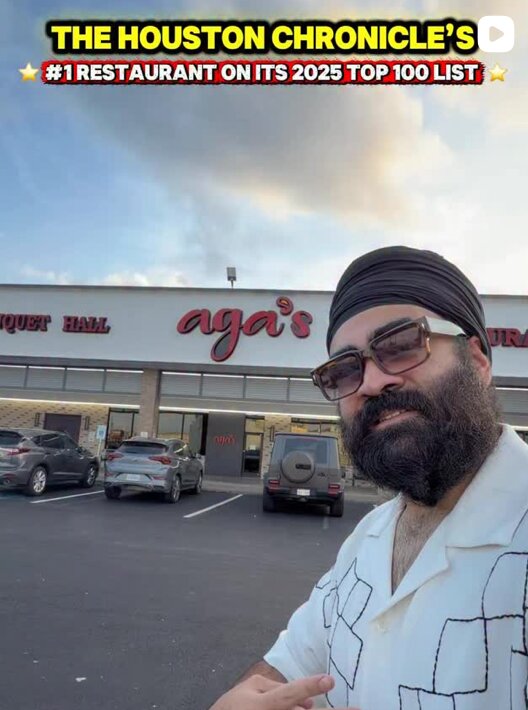
Shawn Singh is known as @ShawnTheFoodSheep on TikTok, Instagram and YouTube, where you’ll find his videos about Houston’s culinary destinations and cultural events. He’s often recognized “IRL” (in real life) when he’s out in the community.
Back in 2021, Singh was working toward his MBA at Pepperdine University when he launched on TikTok and set a goal to produce one video a day for an entire year.
“With every post, you become a better videographer, a better storyteller,” he said. Over time, he amassed considerable followings on TikTok (254,900), Instagram (236,000) and now YouTube (38,700 subscribers).
“My niche is Houston. I’m very passionate about and truly love the city. I love the people here. I’m constantly out talking to people … and I have a close, personal connection with my audience,” he said.
Singh describes his visual storytelling as authentic, transparent and editorially independent.
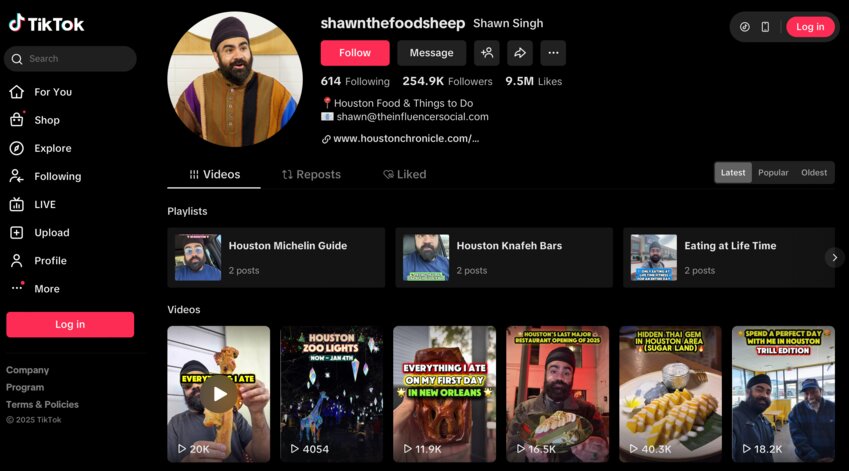
By 2024, he’d landed a six-month brand deal with Snapchat, which allowed him to travel the U.S. and abroad. But he wanted to return to Houston and become known as “the guide for Houston food and things to do.”

At an event, he became acquainted with some of The Houston Chronicle’s newsroom. When the Chronicle received one of API’s influencer grants, they reached out to Singh to help promote “The 100 best restaurants in Houston in 2025” publication. He produced videos about restaurants on the list and provided a “link in bio” back to the digital edition.
Singh still maintains a “day job.” He doesn’t aspire to be a full-time content creator. He’s often asked if he’d like to transfer his skills to a role at a media company. He said he has the highest respect for journalists — especially the professionalism and integrity he’s observed at the Houston Chronicle — but for now, he views the influencer life as a side hustle and creative outlet.
“I like being a freelancer,” he said, citing creative freedom.
To E&P readers considering a creator collaboration, he advised, “It’s all about building relationships with them. … If your organization is doing something compelling, I would say, invite them in.”
 Gretchen A. Peck is a contributing editor to Editor & Publisher. She's reported for E&P since 2010 and welcomes comments at gretchenapeck@gmail.com.






Comments
No comments on this item Please log in to comment by clicking here