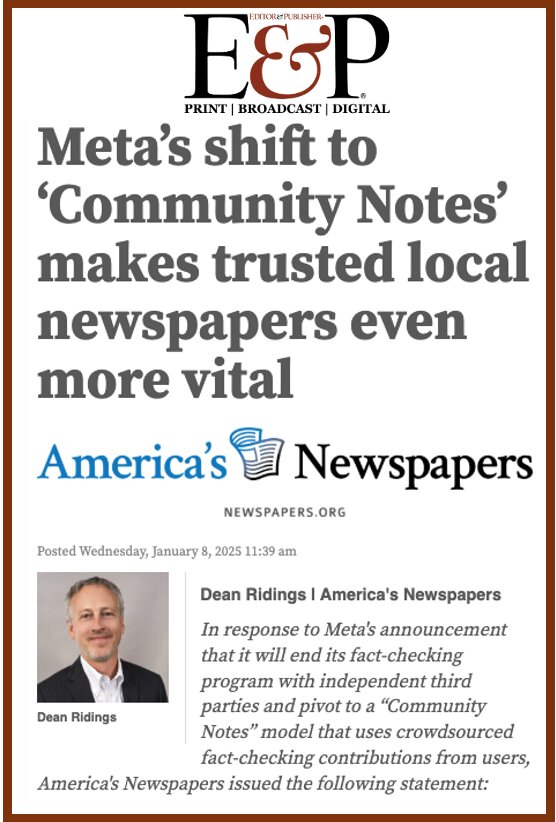
Meta’s recent announcement to end its third-party fact-checking program by January 2025 has sent ripples through the media and fact-checking industries. To unpack the implications of this decision, Editor & Publisher Publisher Mike Blinder spoke with Katie Sanders, editor-in-chief of PolitiFact, a Pulitzer Prize-winning fact-checking organization under the Poynter Institute.
The end of an era: Meta’s move away from fact-checking
Meta’s plan to replace its program with a community-driven content moderation model, similar to X’s (formerly Twitter’s) Community Notes, raises significant questions. According to Sanders, Meta’s transition could open the floodgates to more unchecked misinformation.
“We think platforms like Facebook, Instagram, and Threads are going to attract much junkier content,” Sanders stated. “People are likely to fall for scams and clickbait that, for the last eight years, came with warning labels identifying them as false.”
Sanders emphasized the wide scope of PolitiFact’s work within Meta’s fact-checking program, which extended far beyond political claims. “We covered all flavors of online content—public health misinformation, consumer scams, and even AI-generated graphics. It was always about helping people avoid falling for hoaxes,” she explained.
Community Notes: a replacement or a step backward?
When Sanders was asked whether X’s Community Notes model could adequately replace the thoroughness of professional fact-checking. Sanders expressed skepticism about its effectiveness, noting key differences between the two approaches.
“Community Notes attaches context to only a fraction of false claims,” she said. “The approval process, requiring consensus from users across political divides, makes it hard to scale. This consensus-based approach isn’t suited to combat widespread misinformation.”
Sanders highlighted the benefits of PolitiFact’s in-depth method, which pairs rigorous research with transparent sourcing. “It takes more time—sometimes a day or two—but thoroughness is what people will miss most,” she added. Sanders also lamented the missed opportunity to combine professional fact-checking with community-driven approaches. “We wish we could’ve had conversations with Meta about blending the two models.”
What does this mean for journalism?
Meta’s decision raises broader questions about its relationship with the news publishing industry. Historically, the company has faced criticism for its inconsistent support of credible journalism. Sanders was asked whether this move signals further disinvestment in supporting trusted news sources.
“We don’t have plans to retreat,” Sanders affirmed. “Journalists, not just fact-checkers, need to pay attention to how influencers and regular users talk about major events. This is a brave but essential exercise in countering false information.”
Drawing parallels between misinformation and natural disasters, Sanders warned of the chaos unchecked claims can create. “When disasters strike, false narratives—like conspiracy theories about relief efforts—spread quickly, breeding distrust when people need clarity the most.”
Sanders urged news publishers to embrace fact-checking as a necessary tool, not censorship. “Holding people to account isn’t censorship,” she said. “Fact-checking equips people with the information they need to decide for themselves.”
The cost of truth: challenges in a polarized era
Sanders also touched on the personal toll fact-checking takes on journalists in today’s polarized environment. Sanders acknowledged that her team frequently faces hate and threats, especially women and minorities on staff.
“Yes, this work comes at a cost,” she admitted. “We train reporters to defensively prepare and lock down their profiles. We also have plans in place to handle threats when they escalate.”
Despite these challenges, Sanders underscored the importance of newsroom support systems. “We don’t hide when we’re under pressure. Instead, we rally around each other to provide the support needed to continue this work.”
How news publishers can support fact-checking
As the conversation concluded, Sanders was asked how news publishers could support PolitiFact and the broader fact-checking community. She responded with a call for more open conversations about the value of fact-checking in journalism.
“Fact-checking isn’t a fad, nor should it be treated like a dirty word,” she said. “It helps journalists parse the spin from leaders at every level—national, state, and local. We need to be specific about the value this brings to the industry.”
Sanders also encouraged publishers to educate audiences about what fact-checking truly entails. “Our process page on PolitiFact.com is a model of transparency,” she said. “It explains how we decide what to check, our methods, and our funding. News organizations should prioritize similar transparency.”
Moving forward
Despite the uncertainties Meta’s decision introduces, Sanders remains steadfast in PolitiFact’s mission. “We’ve always been about adding context and providing vetted sources. Encouragement is welcome, but so are criticism and new ideas. We’re here to listen.”
For more on PolitiFact’s work, Sanders invited readers to visit PolitiFact.com or reach out directly at KSanders@politifact.com.
 |
 |








Comments
No comments on this item Please log in to comment by clicking here