
In one of many classic scenes from the movie “The Matrix,” the lead protagonist, Neo, is confronted with a choice. Neo, suspicious about events all around him but blind to reality, is taken to a room where he meets Morpheus, the leader of a serious, mysterious group of outsiders who seem to know important things.
Morpheus, played by a stoic Laurence Fishburne, sits in front of Neo, played by Keanu Reeves, and says: “You take the blue pill — the story ends, you wake up in your bed and believe whatever you want to believe. You take the red pill — you stay in Wonderland, and I show you how deep the rabbit hole goes.”
Morpheus is offering Neo the truth, not the world his brain has been programmed to believe.
In a broad sense, investigative journalists dispense red pills to the curious public. And if there ever were such a thing as The Matrix, a machine-built artificial intelligence simulation that controls our minds, it would be a safe bet that people involved at Lighthouse Reports would be cracking the code.
It’s the kind of thing they do.
Lighthouse Reports is a remote-first, international organization of more than 30 people. It operates as a collaborative engine that works with journalism entities worldwide to bring truth to light. The team spans the U.S., Europe and Asia. Lighthouse investigators operate in the background, as their role isn’t to publish, but rather to gather information, sometimes on a large scale, sometimes in clever and sophisticated ways.
Take, for instance, this intro to a project, which can be found at lighthousereports.com:
“In June, a sharp-suited Austrian executive of one of the world’s most significant yet little-known surveillance companies told a prospective client that he could ‘go to prison’ for organizing the deal they were discussing. But the conversation did not end there.
“The executive, Günther Rudolph, was seated at a booth at ISS World in Prague, a secretive trade fair for advanced surveillance technology companies. He went on to explain how his firm, First Wap, could provide sophisticated phone-tracking software called Altamides, capable of pinpointing any person in the world. The buyer? A private mining company, owned by an individual under sanction, who intended to use it to surveil environmental protestors. ‘I think we’re the only ones who can deliver,’ Rudolph said. What Rudolph did not know: he was talking to an undercover reporter from Lighthouse.”
That sounds like the opening of a sci-fi thriller. We’ll call it Matrix-adjacent.
The story, called “Surveillance Secrets,” was co-published with 70 journalists from 14 publications, including Lighthouse Reports, Reveal, Mother Jones and Le Monde, one of the leading news organizations in France. In that story, a Lighthouse reporter found a vast archive of data on the deep web, containing more than 1 million tracking operations.
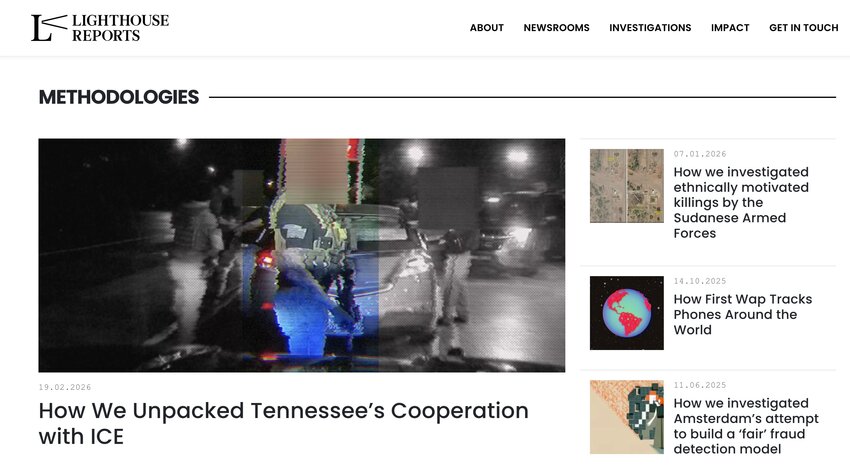
Lighthouse Reports is based in the Netherlands. Its associates have reported on major stories in Sudan, Afghanistan, France, Syria and others. It does have some U.S.-based journalists. Among recent projects in the U.S. is a deep dive into Immigration and Customs Enforcement agents in Tennessee. After ICE had claimed that 200 of the “worst of the worst illegal criminal aliens” were arrested in Nashville, Lighthouse Reports took a closer look, finding that the state highway patrol and ICE racially profiled drivers and that most of those arrested had no criminal record.
The federal government launched a similar operation, the “Memphis Safe Task Force,” in Memphis.
Lighthouse Reports partnered with Mother Jones, the Nashville Banner, Nashville Noticias, NewsChannel 5 and the Institute for Public Service Reporting on the story. They examined thousands of pages of ICE documents, hundreds of court records and more than 50 hours of dashcam and bodycam footage. The reporting found that 75% of those detained in Nashville had no criminal record, and that Troopers abandoned other responsibilities to help ICE make arrests, targeting Latino neighborhoods.
“For the first time,” according to Lighthouse Reports’ website, “using a vast federal database, the investigation was also able to track those targeted, from their arrests on the street through the immigration detention system and onto deportation planes.”
There’s an acronym that vaguely describes what many of Lighthouse Reports’ employees do: OSINT. It stands for open-source intelligence. It includes digital forensics, social media analysis, the verification and reconstruction of complex videos, and the systematic analysis of large datasets. It involves satellite imagery analysis, data scraping and visual evidence synthesis, such as reviewing massive volumes of CCTV footage.

Jack Sapoch, stationed in Portland, Maine, is one of four OSINT investigators for Lighthouse Reports. He’s been with the organization for five years. His work includes social media analysis and the reconstruction of videos and imagery.
“So much of what we do is taking information that’s out there and applying our practitioners’ focus to distill it down into something that's actually useful,” said Sapoch. He’s been investigating how certain shipments ended up in the hands of armed groups. He’s using ship-tracking data, cross-checking it against LinkedIn or Facebook posts, and overlaying it with satellite imagery to narrow down who and what are going where.
Sapoch explained another investigation, in which Lighthouse did a grueling forensic reconstruction of the Ciudad Juárez detention center fire, which killed 40 and injured 27. The team spent weeks analyzing 160 hours of CCTV footage alongside thousands of autopsy photos. They synthesized this dense visual data into a clear narrative, providing the precise evidence needed to hold institutions accountable for the fire’s deadly consequences.
Sapoch and other team members found that “basically all of these guys died right next to the cell, and there was a door that could lead to the outside. So, it seemed it should be very easy for people to be led outside.”

Editor’s Note: Lighthouse Reports, along with La Verdad and El Paso Matters, was awarded the 2024 EPPY award for Best Investigative/Enterprise Video (with fewer than 1 million unique visitors) and 2nd place for Best Collaborative Investigative/Enterprise Reporting (with fewer than 1 million unique visitors) for “Smoke and Lies: Uncovering the truth about the Ciudad Juárez fire.”
Yet another investigation detailed how the U.S. government financed a “covert campaign to downplay the dangers of pesticides around the world, in particular in Africa,” according to the organization’s 2024 annual report. “We uncovered a members-only website that hosted profiles of hundreds of scientists, politicians and campaigners who had been critical of pesticides.”
All this sleuthing takes an incredible amount of knowledge, work and coordination. Lighthouse Reports provides all three. What it doesn’t do is build an audience. Thus, it’s not a household name — anywhere.
“From the very beginning … we increasingly work with creators and channels for distribution that are already connected to their audiences and know them really well," said Ariadne Papagapitos, the impact director for Lighthouse. “Everything that we do is done in collaboration … we form these teams that include Lighthouse people, journalists, technical experts and people from partner publications.
“We have to build relationships of trust from the very beginning … that work is really important to us, but it’s also time-consuming.”
The journalism projects can begin from different places, a mix of internal idea generation and external pitches.
Each project undergoes a vetting process in which the team evaluates the potential impact of the story and whether the project needs the type of resources Lighthouse provides.
Sapoch described the working process as a crescendo that starts small, with layers added as the project proceeds.
“So oftentimes, we’ll encourage the different media partners on the piece to write and publish pieces that serve their audiences as best as they can, but we’ll have a key core findings document that’s fact checked, that everybody can pull from,” Sapoch said.
Added Papagapitos: “A big part of what we bring to these collaborations is the project management side, and those workflows. … We’ve had to get really good at asynchronous work. And then, from my vantage point, a particular challenge is building an impact strategy. Our investigations are kind of spread across geographies, constituencies and issues, and so we don’t want (logistics) to ever be what stands in the way of ensuring that our findings are reaching people ...”
Lighthouse Reports began in 2019, Papagapitos said. The organization’s founders believed that correspondents and journalists were busy chasing stories, but lacked the time and resources to fully investigate deep stories that required intense digging. Lighthouse was built to supply the time and digital forensic skills needed to do impactful work.
Lighthouse Reports is a nonprofit organization that relies on donors who do not impose conditions that restrict the journalism. In 2024, according to its annual report, it took in about $2.4 million.
“I think what we are committed to is the idea that meaningful content isn’t necessarily defined by topic or format, but by the extent to which it actually serves and connects with audiences,” Papagapitos said. “And that even with a model like ours, where we don’t have one static audience, we can still build out an impact plan and have ... stakeholders around an issue inform how we do our work and how we distribute our work.”
On its FAQ page, Lighthouse Reports answers the question of why investigative journalism is important:
“Investigative journalism requires persistence, high standards and the capacity to admit when you’ve gone down a blind alley. It’s most often complicated, slow and costly. In a troubled industry, the commercial temptation is to retreat [from investigations].
But every study on investigative journalism has shown its society-level return on investment is immense. It is a precondition for accountability, democracy and the rule of law. Without it, there is no capacity to uncover what’s being deliberately hidden; to illuminate systems; or hold powerful actors to account. And far fewer starting points from which civil society can push for change. The inputs in terms of disciplines, data and skills feeding into investigations are growing. The outputs from hard news and new media are proliferating into dramatic fiction. In between these two, a small, dedicated corps of journalists can have a big impact.”
Like that small, dedicated corps led by Morpheus, Trinity, Neo, Tank and the underground crew in the Matrix, Lighthouse Reports is opening the public's eyes, one important story at a time.
 Bob Miller has spent more than 25 years in local newsrooms, including 12 years as an executive editor with Rust Communications. Bob also produces an independent true crime investigative podcast called The Lawless Files.






Comments
No comments on this item Please log in to comment by clicking here