
“Journalism really doesn’t have a lot of safety nets.”
That’s how a local journalist, a 20+ year veteran at a major metropolitan daily, described the financial pressure that led them to pick up gig work training AI software. They told E&P they have been working since February 2024 with Outlier, a platform owned by Scale AI, to improve large language models (LLMs) and other AI tools.
“I was bringing in about $400 per week at first,” they said in a recent interview. “It was something I could do while watching football games, and it made a difference in making ends meet.” They requested anonymity, citing concerns about professional repercussions if it became publicly known that they were doing this work.
AI-tutoring work seemed straightforward: grammar correction, fact-checking and text refinement. At $40 an hour, it was attractive in an environment where traditional freelance assignments were scarce or low-paying. But over time, they said the assignments changed in scope, pay and emotional weight.
“Most of the work I have been doing for a few months is testing AI to see if it would do things they don’t want it to do,” the journalist said. “The assignments are to try to force it into saying something that would encourage someone to do something illegal or harmful … and other things I really don’t want to describe. It was dark. They offered mental health support, which I appreciated, but it still didn’t feel good doing some of the assignments.”
The pay has also diminished. “The rate is now $10 an hour, but that’s really less than it seems because you have to watch hours of training videos before you actually do the assignment, and you aren’t paid for that. There’s a lot of prep work — reading, watching YouTube training videos and studying material — that isn’t compensated. Only the time spent completing an assignment is paid.”

They said assignments appear intermittently, and reviews of submitted work can require redoing tasks. “It just doesn’t feel worth it anymore,” the journalist said. “At first, it seemed like a way to help improve AI and make some money. But now, it’s emotionally taxing, and the pay doesn’t make sense.”
A review of Reddit discussion boards echoes the experiences this veteran journalist described. Users report being rejected after performing well on qualifying tests or finding, after months of work, that they are no longer eligible for assignments. Many discuss declining rates over time, unpaid preparation work and the unpredictability of assignments.
Despite these challenges, the journalist we spoke with recognizes the educational value of engaging with AI systems. “I’ve learned a lot about LLMs. I wouldn’t use it for my journalism writing. It’s not great at that kind of work. But I can see how it might help brainstorm ideas or trim the length of a story. And I now know a lot more about it than I did before.”
Task-based opportunities and industry reach
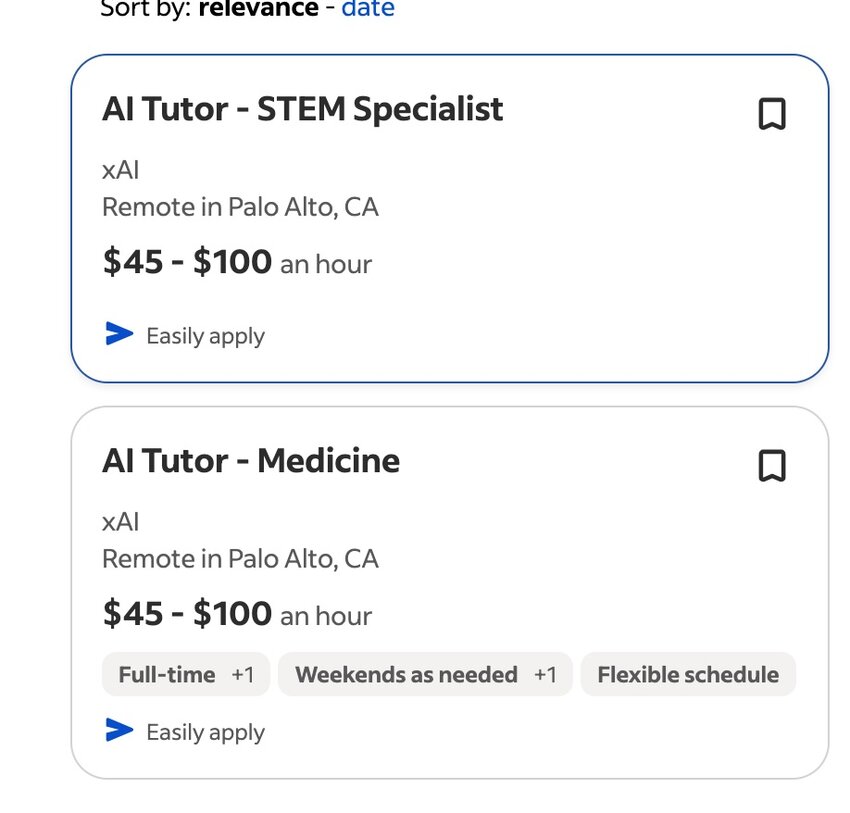
These task-based gigs are sometimes described as annotation, evaluation or tutoring roles — postings for them are offered on platforms like LinkedIn, Reddit, Indeed and Handshake.
A review of the City University of New York’s Handshake job site by E&P showed postings from companies like HireIO and Meeko AI paying $20–$50 an hour for tasks including English-language evaluation of LLM outputs, translation and specialized work in fields like health and education, but none specifically targeted journalists by name. Most English-language jobs on Indeed were found in the $20–$30 per hour range.
Journalists with additional qualifications, such as coding, data analysis or law or engineering degrees, can find higher-paying opportunities. There are also posts for non-English speaking expertise, including for people who speak Spanish, Portuguese, Hindi and Tagalog.
Scale AI, the parent company of Outlier, confirmed that 75% of journalists doing work for the company are based outside the U.S., where they say the journalists’ language skills are valued for their ability to parse nuances in multiple languages. Scale describes Outlier as a “project-based platform focused on advancing GenAI through specialized human expertise,” with tasks ranging from grammar correction to reinforcement learning with human feedback, including evaluating outputs to ensure they are safe and non-harmful.

That’s gig work. It’s not the kind of work that leads to a full-time job at Scale, explained a company representative. Scale said the work is intended to be “supplemental” remote work, and workers receive warnings about any assignments that might be emotionally challenging as well as clear guidance on how much a gig will pay.
Scale AI’s Senior Communications Manager, Fiorella Riccobono, told E&P, “Journalists are an important part of that community because their professional experience directly improves the quality and reliability of large language models. Alongside lawyers, coders, academics and other experts, journalists are helping shape how AI works in the real world.”
Still, there is no way to gauge how many journalists are participating in this work with the dozens of AI-serving companies that have popped up recruiting for these kinds of task-related gigs. Most companies in the space operate with limited transparency about their processes, making it difficult to measure the scope of recruitment. E&P reached out to multiple data annotation companies, and only Scale responded. Riccobono declined to give details on their recruitment practices, saying it is proprietary information for each company doing this work.
Global dynamics and ethical questions
Investigative Journalists Kathryn Cleary and Marché Arends recently published a report in Africa Uncensored examining the global labor market for AI training, particularly in the Global South. Their reporting found that highly skilled workers — including Ph.D.s, multilingual professionals and engineers — were recruited at far lower pay than counterparts in the U.S. or Europe.
Cleary said she first became aware of AI-training work after she was laid off from her staff job at Internews, a global nonprofit supporting newsrooms around the world. Internews lost much of its funding when the U.S. government pulled its support. She sought online AI training work with Mindrift, a subsidiary of the Russian company Toloka.
“My time with Internews was coming to an end with the funding crisis. So, I was looking for other work. I knew that a good career move was to learn about AI technologies,” she explained. “Mindrift got me really good with their marketing on LinkedIn. I was like, ‘Wow, this sounds super cool: Be the I in AI, you can be a writer and an editor.’ And I thought it made sense, right? That a company like this needs journalists because we’re able to edit and refine the junk that the model spits out.”
Cleary said she completed multiple assessment tests with high scores but was ultimately rejected. She began looking more deeply at Mindrift and other companies after she couldn’t get an answer about why she was denied. She said as soon as she started digging into the sector, she grew concerned about what she was learning.
“These companies pay people based on location indexes,” she said. “It’s cheaper for them to hire 10 digital workers in South Africa than one in the U.S., but that was only the beginning.”
She teamed up with Marché Arends, a South African journalist who had learned about the precarity facing AI gig workers in her community. “Getting paid $10 U.S. dollars per hour in South Africa or Kenya isn’t really possible. People get paid much less than that here,” Arends said. Their reporting highlighted many workers who are caught in a cycle of submitting for gigs that either offer low wages or never materialize after hours of unpaid training. “Workers know what’s happening but feel trapped … a lot of these workers have actually used those words.”
Cleary and Arends found that recruitment efforts often exceed the number of available assignments and serve more to inflate the apparent scale of AI service companies. Training is frequently required but unpaid, workers are judged on outputs, and pay structures are hidden.
Both reporters said the biggest issues raised by their reporting were that the recruitment efforts seemed designed to attract highly educated individuals, allowing the companies to showcase a roster of talented people, gaining value and credibility for the AI recruiter, while providing few assignments for those jockeying for work on the platforms.
“This idea of using people as collateral, that’s very disturbing,” Cleary said. “It’s all fueling this concept of artificial general intelligence, AGI and super intelligence. And it’s not real. Honestly. If someone wants to know what AGI is, it’s all the venture capital money sitting in people’s bank accounts.”
Cleary and Arends highlighted the work of the Data Laborers Association, a group that advocates for transparency and improved working conditions for digital workers worldwide.
The freelance landscape
Katherine Reynolds Lewis, founder and executive director of the Institute for Independent Journalists (IIJ), has spent much of her career documenting the challenges facing freelancers and newsroom employees.
“Over my journalism career, I’ve seen so many talented colleagues leave the field. It’s such a loss,” she explained. “I thought, why do we have all of this knowledge, collective knowledge, of how to make it work as a freelancer behind closed Zoom (meetings) or in one-on-one coffees? Why can’t we just make it available to everyone so that it's more sustainable to stay in journalism as a freelancer?”
Lewis is a longtime business journalist, having worked as a staff reporter at Newhouse and Bloomberg, and then as a successful freelancer herself, reporting on financial markets and waves of industry changes and economic shifts. At IIJ, she’s been tracking news layoffs. Her most recent reporting highlighted discrepancies between national job numbers and the real experiences of women and journalists of color in 2024.
She explained how AI is having a direct impact on the field for freelancers, “Media is completely disrupted by AI right now. Editors are scared for their jobs. They’ve experienced newsroom layoffs, and they’re overloaded with work. It’s harder and harder to get their attention, to get an assignment or to get feedback on a pitch.”
Lewis said she doesn’t begrudge people taking on task work to help make ends meet, but she also acknowledged that there can be unease with doing so. “This is a very common tension when freelancers are making that choice to take a paycheck for now because they need to get a bill paid, but they know that it’s not going to serve them long term. There can certainly be a lot of shame,” she explained. She likened it to the early 2000s, when content farms proliferated and many freelancers felt embarrassed about churning out high volumes of low-value content.
For some freelancers doing AI gig work, like the anonymous journalist we spoke with, that calculus has shifted over time. “What started as a way to supplement income at a competitive rate of $40 an hour has dwindled to tasks paying as little as $10 per hour, not accounting for unpaid training,” they explained. “I used to talk about doing this work more openly, but doing this work has a stigma, and I just don't feel good talking about it publicly now.”
While that fear is understandable, Lewis worries silence about working conditions can lead to field-wide problems, “The more that we as freelancers share information about the actual work we’re getting — about the pay and the working conditions — the more other people can make informed decisions.”
Lewis noted a distinction between traditional freelancing and platform-based gig work that can serve a journalist’s long-term career. “I think there is a difference between working as a professional who’s an independent contractor, who scopes an assignment with a client and delivers it, versus being on a platform where you’re sort of served work, and you’re more like a race to the bottom in terms of pay and quality of working experience.”
The final bit of advice Lewis would give to people doing short-term gig work is to keep your eye on your goals, “Remember that every hour you spend doing work that’s not ideal or aligned with your values is an hour that you have not spent looking for better work. If you feel you must do it for now, give yourself a deadline and carve out at least one or two hours a week to look for better work so you’re not stuck.”
 Diane Sylvester is an award-winning 30-year multimedia news veteran. She works as a reporter, editor, and newsroom strategist. She can be reached at diane.povcreative@gmail.com






Comments
No comments on this item Please log in to comment by clicking here