
In late August, Pew Research Center published a revealing look at how fellow Americans regard journalists. They surveyed — online and by telephone — 9,397 U.S. adults and hosted nine 90-minute focus groups to produce “How Americans View Journalists in the Digital Age.”
“Pew Research Center has been studying how Americans get news and information for many years, and it has become clear that journalists’ place in society has been changing amid major political and technological shifts. So, we asked everyday people for their views on this topic, including how they define a ‘journalist,’ how they view journalists’ role in America, and what they want from their news providers more broadly (whether they are journalists or not),” the authors explained in the introduction.
Some good news and some bad news emerged from those conversations.
“Most Americans say journalists are at least somewhat important to the well-being of society. At the same time, many are critical of journalists’ job performance and say they are declining in influence, an opinion that follows years of financial and technological turmoil in the news industry,” the authors gleaned.
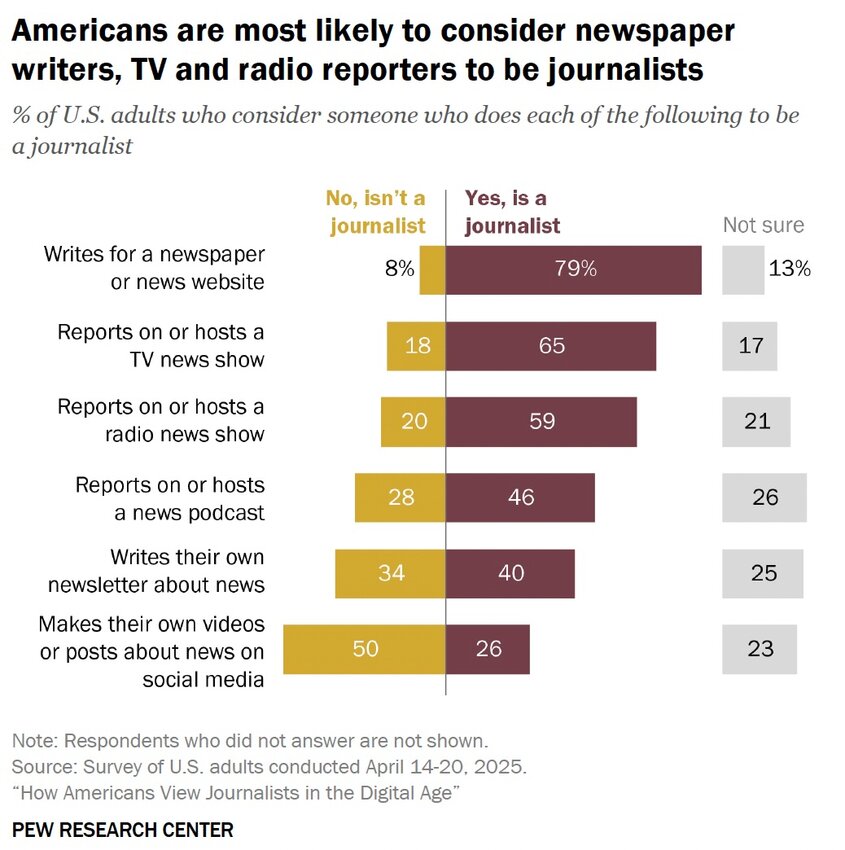
The authors also sought to understand the traits the public values. Ninety-three percent said they value honesty; 89% feel intelligence is important, and 82% cited authenticity as being important. “But what exactly is authenticity?” the authors asked.
E&P put the question before several newsroom leaders.
The Colorado Sun’s Editor Dana Coffield said authenticity is “an amorphous concept.”
“I hear the word authenticity used to describe why news and news-adjacent creators on social platforms can do so well with younger audiences — seeing the faces of people presenting the news seems to lend a feeling of realness about the sources, like a trusted friend telling them the story,” Coffield suggested.

“It has definitely made me think about authenticity as we do some long-range strategic planning and also as we think about how to cultivate and retain new, younger audiences,” Coffield said. “How do we go about our work in a way that lets new readers and communities feel confident that the information we are presenting to them is legitimate and that we aren’t reporting in the communities for purely extractive purposes? We went through the Trust Project audit and certification, and I think that work went a long way toward signaling our authenticity — bios for everyone on staff and a way to connect with any of us; clear descriptions of our values and our ethics; promising to make corrections; and sharing our reporting methods and data for our bigger-deal stories.
“I've also been thinking about it in the context of the threat — real or perceived — of AI-generated content. I feel like authenticity is our best defense against machine-generated content. We are real people who show up in communities to tell the stories of other real-life people. We are accountable to the communities we serve, and we strive to make and maintain real, truth-based connections.”

Yvonne Mintz, publisher and editor of The Facts, a Southern Newspapers title in Texas, said: “Authenticity is really about being true to who you are all the time — in private and with your readers.”
Mintz, who started as a reporter with The Facts 25 years ago, says longevity helps foster authenticity. When the public notes your professionalism for many years and essentially lives through significant events with you through your reporting, it feels more authentic, she said. Being a member of the community also helps.
“They hear this big, bad overarching term — ‘the media’ — but they come to realize that you’re just a person who pays taxes in their community, who sends your kids to school in the community. … They see you as more relatable, that you’re ‘just like me’ and that ‘you’re on my side,’” Mintz concluded.
 Gretchen A. Peck is a contributing editor to Editor & Publisher. She's reported for E&P since 2010 and welcomes comments at gretchenapeck@gmail.com.






Comments
No comments on this item Please log in to comment by clicking here